VRML Wavelet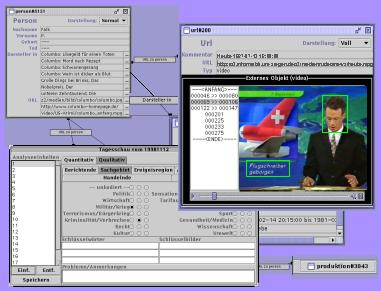
Duration
2000 - 2001Summary
A computer-based workplace for media researchers is developed which consists of tools facilitating the management and analysis of media data (i.e. text, image, video documents). Many tools are specifically designed for media researcher in order to precisely map their way of working and analysis. The workspace mainly consists of:
-) data and media management tools in order to manage public and private media documents, their attribute data and desciptive meta data;
-) automatic image and video analysis tools in order to generate relevant information about their structure and content (three analysis tools are developed: cut/shot detection, text detection and face detection); and a
-) graphical user interface which supports editing, retrieval and visualization tools for all kind of data used by the media researcher. An important feature is the visualization of relationship data existing between different data and media objects.
A prototype of this workplace is already in use.Homepage
Project Z2: Methods and Tools for Computer-based Media Research Analysis of Audiovisual InformationDocuments
[LuttermannFreisleben02]
VRML HistoryDuration
1998- 2000Summary
New compressing techniques are developed which allows to load progressively temporal graphic objects, e.g. temporal meshes, over the internet for visualization on the local display. In the first step only a crude model of the temporal graphic object is transmitted, however, which is good for navigation and first analysis. Then, the model will be refined by continuously loading additional information until the complete model is transmitted. The techniques are based on progressive meshes and the wavelet transformation.Documents
[Luttermann03]
ST-EER ModelDuration
1997- 2000Summary
The standard file format and graphic language VRML is extended with new language concepts which allow an author to describe temporal graphical objects and time values based on valid time (which is different from already supported animation/presentation time). Additionally, a browser is extended which reads, interprets and visualizes this new type of content.Homepage
VRML History HomepageDocuments
[LuttermannLangner00] [LuttermannGrauer99b] [LuttermannGrauer99a] [LuttermannGrauer98b]
ChronosDuration
1995- 1996Summary
The classical Enhanced Entity-Relationship (EER) model, which is used to describe a conceptual view of the application's data structure, is extended with concepts for the description of spatial and temporal aspects of data structures.Documents
[Luttermann96]
Duration
1993- 1995Summary
Tools and techniques for the management and visualization of temporal GIS-data are developed. An implementation of these new tools is integrated in the commercial geographic information system GRADIS-GIS.Homepage
Project CHRONOSDocuments
[LuttermannBlobel95b] [BlobelLuttermann95] [LuttermannBlobel95a] [Luttermann94]
FacemanGo-Moku-Net
Duration
1991- 1992Summary
A face recognition software is developed based on the Principal Component Analysis (PCA) and a back-propagation network. In the initialisation phase the system is trained with a set of "known" faces of some persons. Then faces unknown to the system are presented to the system to be detected and assigned to one person. In test runs with 100 faces (selected from the set of faces of 20 persons) a detection rate of 85 % is reached.
Each face recorded in an image is compressed by the PCA and stored as a coordinate vector of a new normalized coordinate system of eigenvectors (the principal components) determined by the set of known faces. The eigenvectors are called eigenfaces since they are similar to faces. The coordinate vector of each face is then presented to a back-propagation network which is trained by the coordinate vectors of the set of known faces.Documents
[GroßLuttermann93]
Duration
1990- 1991Summary
A game program based on neural networks is developed which is used to play the board game Go-Moku (well-known by the name "5-wins"). The software analyses the games move by move, trains the integrated back-propagation network and thus tries to improve its playing technique.Documents
[FreislebenLuttermann96]
last updated at 2003-09-13, H. Luttermann (mail to hartmut@HartmutLuttermann.de)